Choosing a Chinese modular building supplier requires more than checking factory photographs or production capacity. Buyers must ask, “what certifications should modular building manufacturers have” for the target market, building type, and delivery route. Requirements change between residential units, hospitals, classrooms, and steel-framed accommodation. They also change between China, the European Union, the United Kingdom, Australia, and North America.
Tom Hardiman Jr., Executive Director of the Modular Building Institute, has said, “Modular construction is simply a better way to build.” That promise depends on documented controls. ISO 9001 can indicate a structured quality-management system. ISO 14001 addresses environmental management. ISO 45001 supports occupational health and safety practices. Chinese manufacturers may also need product-specific CCC approval, depending on the equipment and application. Exported electrical products may require CE marking, UKCA marking, or other destination-specific evidence. Fire-rated panels, insulation, doors, windows, and structural components often need separate test reports.
Certification is not a magic shield.
A certificate can confirm a management process, but it cannot replace factory inspection. Buyers should review welding records, material traceability, coating thickness, fire-test reports, and dimensional checks. Site audits can reveal details that polished documents miss. A damp storage corner, incomplete inspection tag, or substituted component deserves attention. I would also avoid assuming that one international certificate satisfies every local code. That assumption is easy, and sometimes expensive. A qualified code consultant should verify approvals before manufacturing begins. This guide examines the practical certifications, testing documents, and quality evidence that responsible China-based modular building makers should prepare.
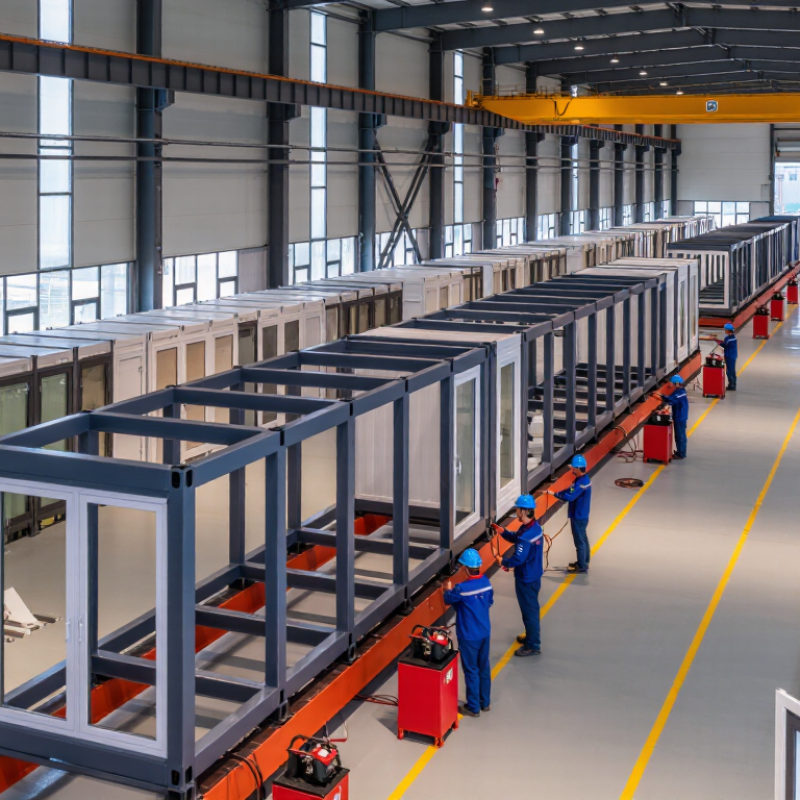
Certification depends on the module’s materials, systems, destination, and installation method. A factory producing steel frames should control welding, traceability, and structural quality under applicable GB standards. ISO 9001 supports documented quality control, while ISO 3834 can strengthen welding management. China’s compulsory product certification may apply to specific electrical components, not automatically to the entire modular building. This distinction is often misunderstood.
The ISO Survey 2023 recorded more than 1.59 million ISO 9001 certificates in China. That figure shows widespread adoption, but certification alone cannot prove factory performance.
Buyers should check the certificate scope, issuing body, expiry date, and audited production site. A certificate covering office management is not enough for steel modules.
Environmental and safety credentials may also matter. ISO 14001 helps manage waste, coatings, water, and material use. ISO 45001 addresses worker risks around cranes, cutting, welding, and confined spaces.
The International Energy Agency reported that buildings consumed about 30% of global final energy in 2022, making energy and carbon evidence increasingly relevant. Export projects may require additional conformity assessment, fire testing, electrical reports, or structural approval in the destination market.
Requirements change by project. That is the difficult part. A careful compliance matrix is still necessary.
What Certifications Do China Modular Building Makers Need?
For China modular building makers, certification begins with a controlled factory, not a polished certificate wall. A practical quality management system usually follows ISO 9001 principles. It should define purchasing, incoming inspection, production checks, nonconformity control, and final release. Each module needs traceable records, including steel batch numbers, welding reports, electrical tests, and dimensional inspections.
Factory certification is established through documented procedures, trained personnel, calibrated equipment, and independent audits. An accredited certification body reviews the management system and checks whether daily operations match written procedures. Regular surveillance audits are important because factory conditions can change after the initial approval. Environmental and occupational safety systems may follow ISO 14001 and ISO 45001, depending on the project and buyer’s requirements.
Product compliance is separate from management certification. Destination-country rules may require structural calculations, fire-performance evidence, energy data, electrical testing, or conformity assessment for installed components. A reliable manufacturer should provide the certificate scope, validity period, issuing body, and supporting test reports. Documents should match the actual factory and product model. This detail is often overlooked.
Experience shows that a certificate alone cannot guarantee consistent modules. Paperwork can look complete while a process remains weak. That gap deserves attention. Buyers should compare audit findings, corrective-action records, sample inspection results, and shipment history. Independent pre-shipment inspections can reveal practical defects, such as loose fittings, damaged insulation, or incorrect labels, before modules leave the factory.
| Certification or Compliance Area | Primary Purpose | Typical Applicability to Modular Building Production | How It Is Established | Typical Evidence and Records | Important Qualification |
|---|---|---|---|---|---|
| ISO 9001 Quality Management System | Controls consistent product quality, documented processes, customer requirements, corrective actions, and continual improvement. | Highly relevant for factories producing steel frames, volumetric modules, wall panels, MEP assemblies, and finished modular units. | Define the quality-management scope, map production processes, establish procedures and records, conduct internal audits and management review, then pass an audit by an accredited certification body. | Quality manual or process documentation, inspection plans, supplier evaluations, calibration records, nonconformity reports, training records, and audit reports. | ISO 9001 certification confirms the management system; it does not by itself certify every building design or guarantee a specific product’s regulatory approval. |
| ISO 14001 Environmental Management System | Manages environmental aspects, legal obligations, resource use, waste, emissions, and improvement targets. | Useful where projects or customers require environmental controls for factory operations, construction materials, packaging, and waste handling. | Identify environmental aspects and impacts, evaluate compliance obligations, set objectives, implement operational controls, audit the system, and complete third-party certification. | Environmental-aspect register, waste-transfer documentation, permits, emergency plans, monitoring results, objectives, and corrective-action records. | It is a management-system certification rather than a product-level declaration of environmental performance. |
| ISO 45001 Occupational Health and Safety Management System | Reduces workplace risks and establishes controls for worker safety, incident response, consultation, and continual improvement. | Relevant to factories using welding, cranes, cutting equipment, lifting operations, chemicals, electrical systems, and assembly lines. | Assess hazards and risks, establish controls, provide training and personal protective equipment, conduct inspections and drills, investigate incidents, and undergo certification audits. | Risk assessments, safe-work procedures, training and competency records, equipment inspections, incident reports, emergency drills, and internal-audit results. | Certification does not replace applicable Chinese occupational-safety laws, permits, or project-specific safety requirements. |
| ISO 3834 Welding Quality Requirements | Provides quality requirements for fusion welding of metallic materials, including personnel, procedures, equipment, inspection, and records. | Important for welded structural frames, chassis, steel modules, connection plates, brackets, and other load-bearing assemblies. | Select the appropriate ISO 3834 quality level, appoint responsible welding personnel, qualify welding procedures and welders, control materials and consumables, and complete assessment by a competent body where required. | Welding procedure specifications, procedure qualification records, welder qualifications, material certificates, weld maps, inspection reports, and traceability records. | The required level depends on design, service conditions, applicable codes, and customer or project specifications. |
| EN 1090 Factory Production Control | Supports conformity assessment for structural steel or aluminium components placed on the European market under applicable construction-product requirements. | Relevant when a modular building maker supplies structural metal components or kits covered by the applicable harmonised European standard. | Establish factory production control, identify the execution class, qualify welding and inspection arrangements, undergo notified-body assessment where required, and maintain continuing production records. | Factory-production-control manual, design and execution records, welding qualifications, material traceability, inspection results, nonconformity controls, and declarations of performance where applicable. | Applicability must be checked against the exact product, market route, harmonised standard, and current European regulatory requirements. |
| CE Marking and European Product Compliance | Demonstrates that a product meets applicable European Union health, safety, and environmental requirements before being placed on the relevant market. | May apply to specific construction products, machinery, electrical equipment, pressure equipment, or structural components incorporated into a modular building. | Identify applicable legislation and standards, determine the conformity-assessment route, perform testing or assessment, prepare technical documentation, issue the declaration of conformity or performance, and affix the marking when legally permitted. | Technical file, risk assessment, test reports, drawings, standards list, instructions, declarations, and notified-body documents when the conformity route requires them. | CE marking is not a universal quality certificate and is not automatically required for an entire modular building as one product. |
| China Compulsory Certification and Domestic Compliance | Addresses mandatory Chinese conformity requirements for specified product categories and regulated components. | Potentially relevant to electrical products, cables, switches, appliances, fire-related equipment, and other components included in a modular building. | Confirm whether each product category is included in the current mandatory catalogue, use an authorised testing or certification route, complete factory inspection where required, and maintain certificates and surveillance records. | Product certificates, test reports, factory-inspection records, product labels, supplier certificates, and incoming-material verification records. | Requirements depend on the specific product category; a modular-building factory is not automatically required to obtain one certificate covering the whole building. |
| Building-Code, Fire, Structural, and Local Approval Compliance | Confirms that the building design and installation comply with the codes and approval rules of the destination market. | Essential for foundations, structural resistance, fire safety, energy performance, weatherproofing, accessibility, plumbing, electrical systems, and site installation. | Use qualified design professionals, select applicable national or local codes, complete engineering calculations and product tests, submit documents to the relevant authority or reviewer, and obtain project approvals. | Stamped drawings, calculations, test reports, fire classifications, installation manuals, inspection records, permits, and completion documentation. | This is project- and jurisdiction-specific; management-system certificates cannot substitute for statutory building approval. |
| Factory Audit and Supplier Qualification | Provides customer-specific verification of production capacity, process control, traceability, ethical practices, and delivery capability. | Common for international buyers evaluating a factory before approving it for a project or framework supply agreement. | Review factory documents, inspect production lines, sample finished products, interview responsible personnel, verify records, issue findings, and close corrective actions. | Audit checklist, capacity records, process flow, inspection plans, traceability samples, equipment-maintenance logs, corrective-action evidence, and ethical-compliance documentation. | A customer audit is normally a qualification assessment, not an independent certification valid for every buyer or market. |
| Certification Maintenance and Surveillance | Keeps certified systems and approved production processes effective after the initial certification decision. | Applies to management-system certifications and many product or factory-control schemes that require periodic review. | Conduct internal audits, review performance, manage changes, close corrective actions, complete scheduled surveillance audits, and undergo recertification according to the applicable scheme. | Current certificates, audit schedules, management-review minutes, KPI records, corrective-action logs, change-control records, and updated scope statements. | Certificate scope, validity, issuing body, accreditation status, and applicable product or project requirements should always be verified independently. |
A modular unit has no single global certification. Its required approvals depend on the destination country, building type, and installation site. China-based manufacturers should map these requirements before production begins. A residential module may need structural, fire-resistance, thermal, acoustic, electrical, plumbing, and ventilation evidence. Commercial units often require additional accessibility and public-safety documentation.
Material records are equally important. Steel should include mill test reports, grade information, and traceability from batch to frame. Welding procedures, welder qualifications, and inspection records support structural reliability. Insulation may require thermal-performance and fire-classification reports. Interior panels, flooring, adhesives, and coatings can need VOC or formaldehyde test results. Electrical components should carry approvals accepted in the target market, not only domestic factory certificates. That distinction matters.
Quality-management certification can show controlled production, but it does not automatically certify a finished building. This is where buyers sometimes misunderstand factory capability. A neat workshop is not enough. Test reports should identify the exact product, material, standard, laboratory, and test date. Documents should also match the shipped configuration. Small changes can invalidate earlier evidence. In practice, a missing revision number or unclear material grade can delay approval. The process is rarely perfect, and requirements may change during design review. Early consultation with an accredited testing body, local engineer, or building authority reduces expensive rework.
What Certifications Do China Modular Building Makers Need?
Building codes shape certification needs more than the factory’s location. Each destination applies different rules for structure, fire safety, electricity, plumbing, energy use, and accessibility. A modular building may pass factory inspections but still need approval from the project’s local authority. That distinction is often missed.
In practical project reviews, buyers should map every module to the approved drawings and applicable codes. Structural calculations may require review by a licensed local engineer. Steel connections, welding procedures, lifting points, and foundation interfaces need clear evidence. Fire-rated walls, doors, insulation, and internal finishes may require tested assemblies, not separate material certificates. Electrical systems can need inspection before connection to the public grid.
Project approval changes the paperwork.
Manufacturers should prepare test reports, material traceability records, installation instructions, quality-control procedures, and inspection photographs. Some projects also require factory audits or independent inspections before shipment. An ISO quality certificate can support confidence, but it does not replace code compliance or a construction permit.
Transport creates another practical issue. A module may be certified as a product, yet its on-site joints can alter fire or structural performance. Authorities may request additional tests after assembly. This is inconvenient, but ignoring it creates delays. Certification names also vary between jurisdictions, so copied documents can be misleading. A careful compliance matrix, updated with the local designer, is more reliable than a generic certificate folder. The process is rarely perfect. Requirements can change during review.
What Certifications Do China Modular Building Makers Need?
For China modular building makers, export certification and destination-market approval are different responsibilities. Export documents mainly support legal shipment and product traceability. They may include commercial invoices, packing lists, certificates of origin, inspection records, and material declarations. Factory quality systems, such as ISO 9001, can strengthen credibility, but they do not replace building approval.
Destination-market requirements are more specific. A completed module may need structural calculations, fire-performance evidence, electrical testing, energy documentation, and plumbing compliance. Requirements vary by country, region, building type, and intended use. Local authorities may also request permits, third-party inspections, or approval from a licensed engineer. A certificate accepted for export may have little value during site approval.
Tips: Prepare a certification matrix before production. List each component, test standard, issuing body, and responsible party. Confirm whether reports must come from an accredited laboratory. Keep drawings, weld records, serial numbers, and inspection photos together. Small details matter.
Experience shows that problems often arise between factory documents and local code interpretation. A technically sound module can still face delays if its evidence is incomplete. This is easy to underestimate. Certification planning should involve the importer, local consultant, and authority early. Requirements can change, and one checklist may never capture every project condition.
Export documentation is separate from destination-market building approval. The chart shows the main compliance pathways commonly encountered by modular building exporters.
A value of 1 indicates that the pathway is commonly relevant; it does not mean that every project requires the same certificate. ISO 9001 is generally voluntary, while building-code approval, electrical conformity, product marking, and import documentation depend on the product scope and destination jurisdiction.
Usually, no. Requirements depend on materials, systems, destination, and installation method. A factory certificate does not replace project approval.
They should control welding, material traceability, structural checks, and production records. Keep weld procedures, serial numbers, inspection photos, and approved drawings together.
No. It supports documented processes, but its scope matters. An office-management certificate cannot prove steel-module performance.
Sometimes. Specific electrical components may require compulsory approval or testing. The whole modular building is not automatically covered.
Each destination may set different structural, fire, electrical, plumbing, energy, and accessibility rules. Factory inspection alone may not satisfy local authorities.
They may request test reports, structural calculations, installation instructions, material records, and independent inspection results. Local engineer review may also be required.
No. Export paperwork supports shipment and traceability. Destination approval may require fire evidence, electrical testing, energy documents, and local permits.
On-site joints can change structural or fire performance. Authorities may request additional checks after assembly. This is inconvenient, but easy to underestimate.
Prepare a project-specific compliance matrix before production. List each component, standard, testing body, and responsible party. Requirements can still change. Check again.
Determining what certifications should modular building manufacturers have depends on the factory’s production scope, target projects, and destination markets. At the company level, manufacturers commonly establish quality, environmental, occupational safety, and production management systems to demonstrate consistent processes and traceability. These systems support reliable design, fabrication, inspection, and delivery, but certification should match the company’s actual operations rather than be obtained only for marketing purposes.
At the product level, modular units may require documentation for structural performance, fire resistance, electrical systems, plumbing, insulation, energy efficiency, and material safety. Requirements can also change according to local building codes, project specifications, and approval procedures. For export projects, manufacturers may need to meet the standards, testing rules, labeling requirements, and conformity assessments of the destination country. Therefore, certification planning should begin early, with responsibilities clearly divided among the manufacturer, designers, testing bodies, contractors, and local authorities. A complete compliance package should include valid certificates, test reports, material records, quality inspections, and project-specific approval documents.
Nova Build